8 Things to Know Before Designing a Swimming Pool in Dubai
A pool design gets signed off in a meeting that lasts an hour. Shape, tile, coping, lighting, done.
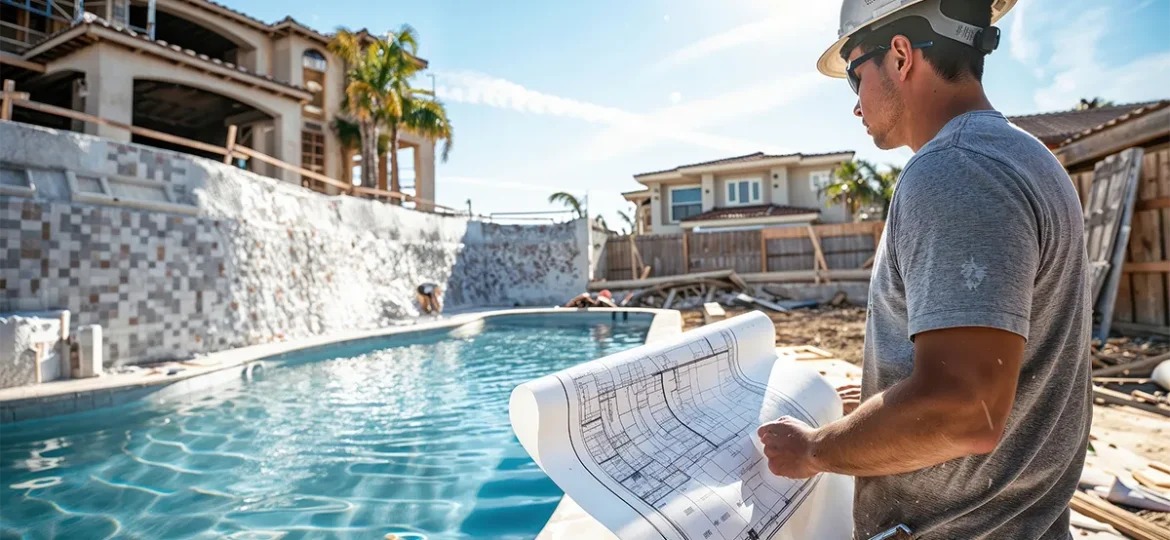
Designing a swimming pool in Dubai means settling a second set of decisions that are rarely on the table in that meeting. They live in the drawings behind it: where the equipment sits, how the approvals sequence works, what the waterproofing spec says.
Those are also the expensive ones to change later. Moving a plant room after the deck is laid means lifting the deck. Finding out at permit stage that your community will not allow the edge detail means redrawing.
So here are the eight things we ask villa owners to settle first, the list we work through in Palm Jumeirah, Emirates Hills, Dubai Hills Estate, Al Barari and District One.
1. Swimming Pool Approvals Come Before the Final Design
Pool construction at a Dubai villa follows a fixed sequence. Your master developer, whether Emaar, Nakheel, Meraas or DAMAC, issues an NOC confirming the design meets community guidelines. That NOC then supports the Dubai Municipality permit application, submitted with structural drawings and calculations for the shell.
Properties in certain zones fall under Trakhees or DDA instead. DEWA approves the electrical and plumbing connections serving the plant room, and Civil Defence reviews safety provisions and barriers.
This matters at design stage because community guidelines can rule out an edge detail, an equipment position or a boundary treatment after you have fallen in love with it. Allow several weeks for the cycle, and longer if drawings return for correction. Incomplete documentation is the most common cause of delay.
2. Your Plot Decides More Than Your Mood Board
Before design, three site facts need establishing: ground conditions, the location of existing utility runs, and machinery access.
The third one catches people out. A villa on a tight plot may have no route wide enough for an excavator to reach the rear garden. That leaves two options: dismantle and reinstate the boundary walls, or excavate with a smaller machine at greater cost and time.
Either way the budget changes. Far better to know that before design than to discover it on mobilisation day.
3. Pool Cooling Is a Design Decision, Not an Accessory
Left untreated through a Dubai summer, pool water can climb past 35°C, at which point it stops being refreshing and most families stop using it from May to September. Winter is the reverse problem, with water cold enough from December to February that few people get in.
A reversible heat and cool pump solves both from one unit. It has to be specified early, because it needs plant space, a power supply and pipework sized around it.
Sizing depends on your water volume, surface area and sun exposure. A pool on an unshaded western exposure needs a larger unit than the same pool shaded by the villa. That is a design decision, made on the site plan.
4. The Plant Room Has to Be Designed, Not Squeezed In
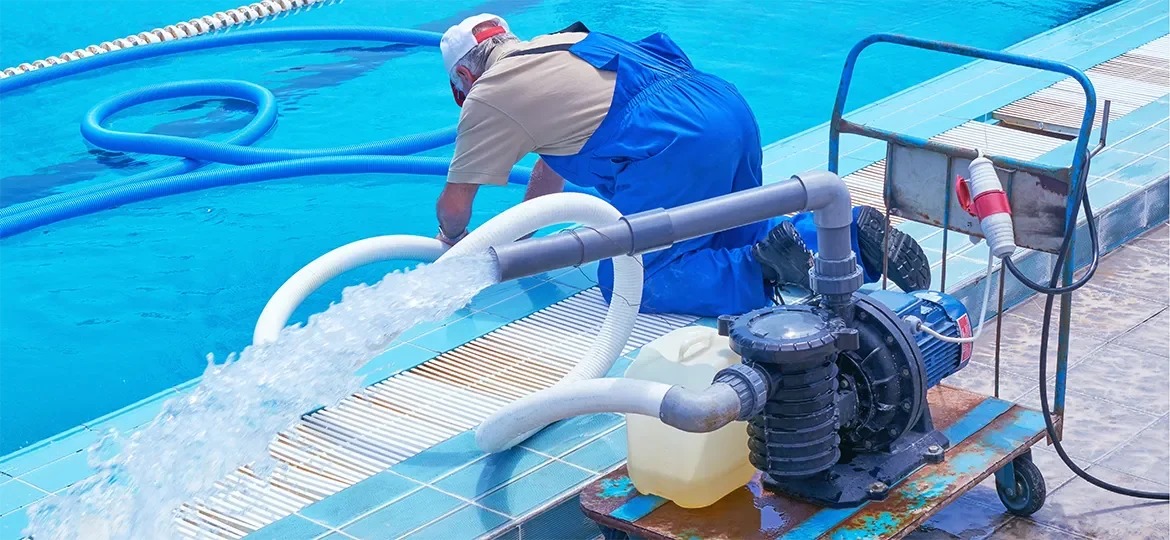
The most neglected drawing on any villa pool. Equipment needs a dry, ventilated space, close enough to the pool to limit hydraulic losses and far enough from bedrooms and the majlis that pump noise is not an issue. It also has to be genuinely accessible to a technician carrying a filter lid.
We have inherited pools where the plant room sat under a paved terrace behind a small hatch. Every routine service on that pool costs the owner more than it should, for the life of the pool, because of a decision made in an afternoon. Specify the pump room location, dimensions and access on the drawings.
5. Waterproofing Is the Part You Never See and the Part That Fails
Almost every leak we investigate through leak detection traces back to plumbing, fittings, light housings or failed waterproofing at a joint, rather than a cracked shell. Waterproofing is invisible on handover day and impossible to assess from a photograph, which is precisely why it is where corners get cut.
Ask for the waterproofing system to be named in the scope, and for its warranty to be stated separately from the general workmanship warranty. A contractor confident in their detailing will do this without hesitation.
6. Pool Water Chemistry Starts at Design Stage
Dubai water is hard and mineral-rich, UV consumes chlorine quickly, and evaporation is high. Three specifications made during design determine how much of a burden that becomes.
Turnover rate, so the full pool volume passes through filtration in a sensible cycle. A variable-speed pump, which is one of the few upgrades that measurably reduces your DEWA bill. And an automatic top-up with proper level control, because a water level that moves means chemistry that moves with it.
If you are considering salt chlorination, decide now rather than later. It is still chlorine, and the salt is aggressive towards some natural stone and untreated metal fixings, so the deck and coping need to be selected around it.
7. The Deck Matters as Much as the Water
Dark natural stone around a Dubai pool becomes too hot to walk on barefoot by midday, which is why many owners now choose light, high-SRI paving to keep decks cooler underfoot. Slip resistance when wet is a separate specification from the material itself, and worth checking rather than assuming.
Barrier and fencing requirements also apply where children use the pool. They are far easier to build into the landscape design than to bolt onto a finished deck afterwards.
8. Budget for Year Three, Not Just Handover
The build cost is the number everyone asks about. The running cost decides whether you enjoy owning the pool. Four things drive it: electricity, dominated by the heat and cool unit; water to replace evaporation and backwash; chemicals, consumed faster here than in temperate climates; and maintenance.
Most villa owners settle on an annual maintenance contract, because pool chemistry in this climate does not tolerate being ignored for a fortnight. The real value is in catching a failing pump seal or a slow leak before it becomes a structural repair.
Why Villa Owners in Dubai Choose Poolsmith
Every pool looks good on handover day. What you are buying is how it performs in its fourth Dubai summer.
Pools Are All We Do
We are not a landscaping firm with a pool division. Swimming pool design, construction, renovation, pump room works and heat and cool units are our core business. The specifications above are written into our drawings by default rather than added on request.
One Point of Contact, Start to Finish
From concept through developer NOC, Dubai Municipality and DEWA approvals, construction and commissioning, you deal with one team. We prepare and submit the approval package rather than leaving it with you.
We Stay After Handover
Our AMC clients keep the same team that built the pool for their ongoing maintenance, with priority response and full transparency on what was done and why.
Frequently Asked Questions
Yes. In a master community you need a developer NOC first, then a Dubai Municipality permit, with DEWA approval for the connections and Civil Defence sign-off where relevant. Building without approval creates a liability that surfaces at resale, when the pool does not appear on the approved drawings.
Design depends on how quickly decisions are made. Approvals typically run several weeks, and longer if drawings come back for correction. We give a stage-by-stage programme alongside the quotation rather than a single headline figure.
It can usually be retrofitted, provided there is plant space and adequate power. The constraint is more often the plant room than the pool. We assess both during a site survey.